
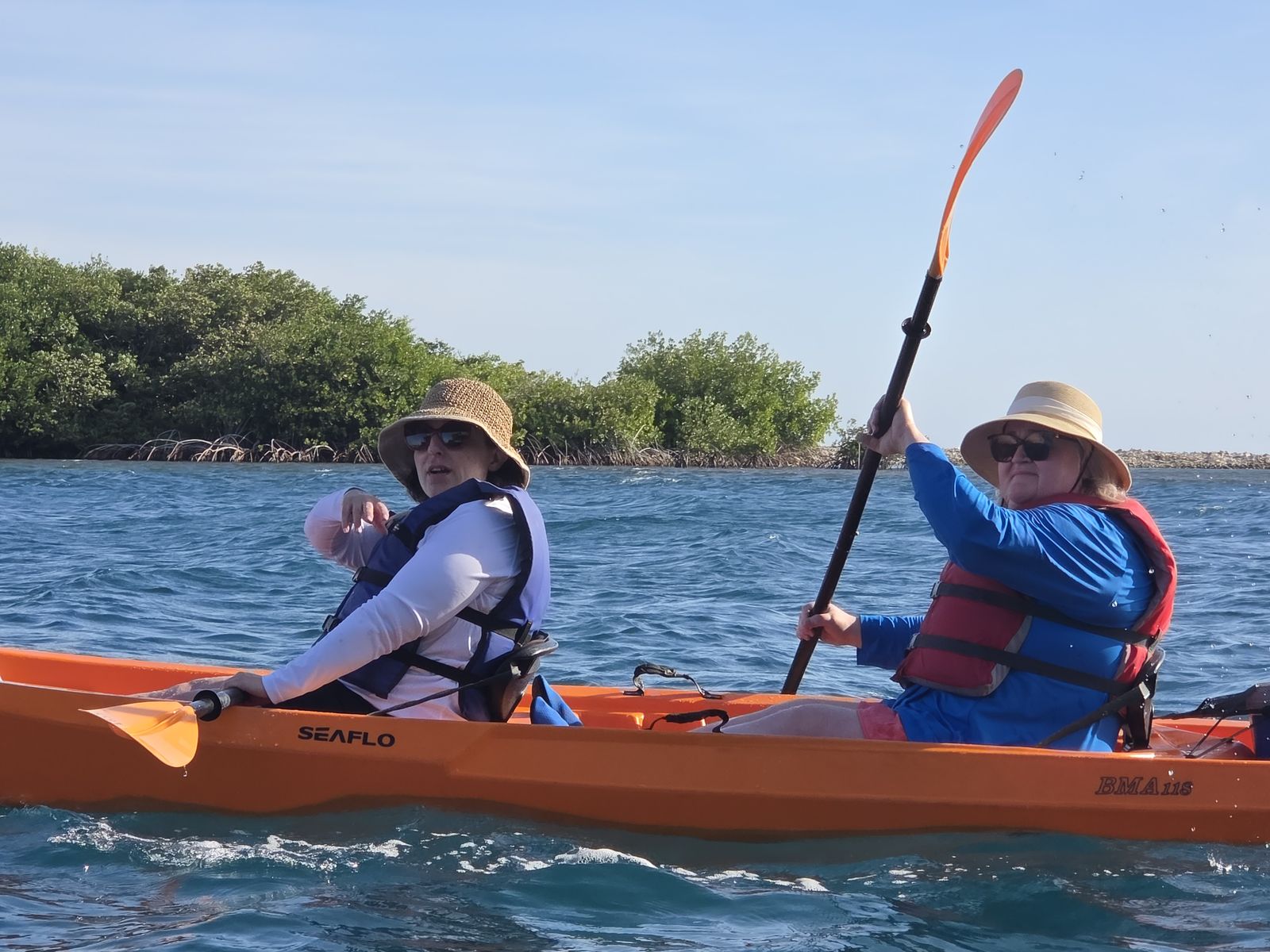
Mangrove kayak and snorkeling eco tour, Aruba
The word eco does a lot of unpaid work in tourism. It gets attached to anything that happens outdoors. So before anything else, here is what this tour literally is: you paddle through mangrove channels on Aruba's sheltered south coast, then you snorkel the reef those mangroves feed, and somebody who grew up on this water explains how the two are connected. That connection is the whole point of the tour.
The mangroves and the reef are one system
Mangroves stand in salt water on stilted roots, which is a strange thing for a tree to do and an extremely useful one for everything else. The submerged tangle is a nursery. Juvenile fish that would be eaten in open water grow up in there, then move out to the reef when they are big enough to survive it. A large share of what you later see over the coral began life a few hundred metres away in the roots.
The roots also trap sediment. Silt that would otherwise drift out and settle on coral gets held in the mangrove mud instead, which is a large part of why the water over this reef is clear enough to be worth swimming in. And the mangrove belt takes the energy out of swell before it reaches the shore.
Take the mangroves away and the reef gets murkier, emptier and more exposed, in that order. That is why we run one tour that does both rather than two tours that pretend they are separate places.
What the paddle through the channels feels like
Quieter than you expect. The channels are narrow and the canopy closes overhead in places, so the wind drops away and the water goes flat and dark green. You hear your own paddle and not much else. There is a smell, faintly sulphurous, which is the mud doing its work.
A kayak fits in here and a boat does not, and that is not a marketing line, it is a physical fact about the width of the channels. It also means the birds stay where they are instead of leaving, because a kayak is low and slow and does not sound like a threat.
Herons and egrets work the shallow edges. Sandpipers pick along the mud. Land crabs move at the waterline and dragonflies hang over the still water. Small fish scatter under the hull in silver bursts. What turns up on your particular morning is the day's luck, which is the honest way to describe wildlife.
Then the reef
The route continues out of the shelter to two snorkel stops, one on the barrier reef and one on the coral garden. This is the part guests talk about afterwards. Parrotfish and sergeant majors are the reliable residents, small schools move through the shallows, and the bottom changes colour under you as the depth changes.
Full snorkel gear is included, so you do not need to rent or buy anything. Basic swimming ability is a participation requirement and life jackets are provided and worn on the water. If you would rather stay on the kayak and watch from the surface at one of the stops, that is a perfectly normal thing to do and nobody will make a thing of it.
What makes a tour eco, and what does not
We do not hold a third party sustainability certification and we are not going to imply that we do. What we can tell you is exactly how we behave on the water, which you can check against us on the day.
The group stops at 10 guests, because a large group in a narrow channel is a disturbance no matter how well behaved it is. We stay in established channels rather than cutting new lines through the roots. Nothing gets touched, stood on, collected or taken home, and that includes coral, shells and anything alive. We do not feed fish, because feeding changes behaviour and the change is not in the fish's favour. We ask for reef-safe mineral sunscreen and we will tell you why if you ask. Everything that goes out on the kayaks comes back on the kayaks.
None of that is heroic. It is the baseline, and the reason to publish it is so you can hold anyone who claims the word to it.
The tour, practically
Departures are daily at 8:30 AM, 1:00 PM and 5:00 PM. The tour runs 2.5 hours and meets at the Mangel Halto beach sign in Pos Chiquito. Arrive 15 minutes before your departure time, because departures cannot be held for late arrivals.
Adults pay $89.99 at our summer rate and children from 6 to 12 pay $69.99, minimum age 6. Kayak, paddle, life jacket, snorkel gear, drinking water and fresh fruit are included. Guides work in English, Spanish and Papiamento. Booking online confirms instantly and cancellation is free up to 24 hours before departure.
The morning departure is the one to take if the mangroves are your priority. The birds are active, the air has not heated up and the water inside the channels is glass. The 1:00 PM slot gives you the strongest light under the water at the reef stops instead.
The company was founded by a veteran Aruban ranger with decades on Aruba's south coast, and the crew leading your tour learned this water from him, including how to move through mangroves without disturbing what lives in them.
Where to next
Read about the place itself on our Spanish Lagoon and Mangel Halto Beach pages, compare this route against the island crossing in Sea Glass Island or Mangel Halto, or check what it costs and what to bring.
Questions guests ask
Do I have to snorkel to join the mangrove tour?
No. You can stay on the kayak at either stop and watch the water from the surface. Most people go in, but nobody is pushed, and the paddling through the channels is worth the trip on its own.
Is this the same as the Sea Glass Island tour?
No. Different route and different meeting point. The Sea Glass Island crossing launches from Savaneta and lands on an island; there are no mangroves on that route. This one meets at Mangel Halto, works the mangrove channels and stops twice to snorkel.
What is the best time of day for the mangroves?
The 8:30 AM departure. Birds are active, the air is still cool and the water inside the channels is completely flat. The 1:00 PM tour trades some of that for stronger light at the reef stops.
Is it suitable for someone who has never kayaked?
Yes. The water inside the mangrove channels is sheltered and flat, which makes it one of the most forgiving places on the island to paddle for the first time. Your guide briefs you before launch and sets the pace to the group.
Choose your adventure
Live availability and instant booking. Pick a date, grab your paddle, and we'll see you on the water.